
 By
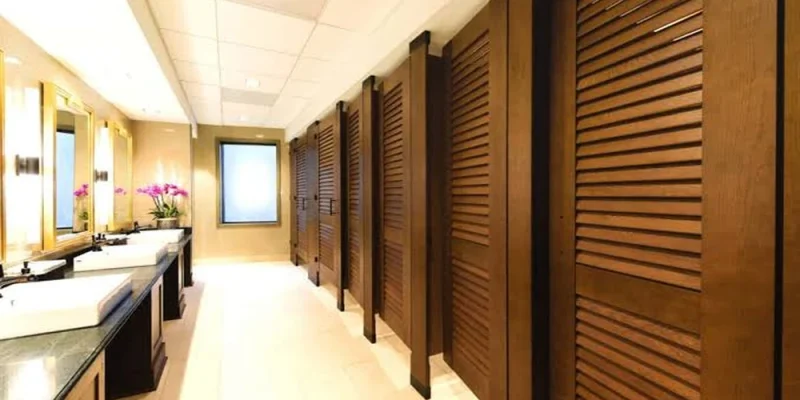
Mounting style is one of the earliest decisions in toilet partition design, and it shapes how a restroom is cleaned for the next two decades. The choice determines what touches the floor, what loads go into walls and ceilings, and how easily custodial crews can reach every surface. In facilities with constant traffic, those differences add up to real hours and real hygiene outcomes.
Why does traffic volume change the mounting decision?
Traffic volume changes the decision because cleaning frequency rises with every user. The busiest airport in the world handled more than 100 million passengers in 2023 (Airports Council International). Restrooms at that scale are cleaned continuously, so any detail that slows a mop or traps debris is multiplied thousands of times a year.
What makes floor cleaning harder?
Floor cleaning becomes harder wherever hardware meets the floor. Pilaster shoes, anchors, and pedestals create edges and corners where moisture and debris collect, and crews must work around each one.
Which mounting styles are available for metal partitions?
Metal partitions are typically offered in four mounting styles, and some manufacturers make all four available within the same privacy-focused product line: floor anchored and overhead braced, floor anchored, ceiling hung, and floor to ceiling anchored (ASI Global Partitions). That range lets designers match structure to the building rather than the other way around.
How do the styles compare for maintenance?
Each style balances cleaning access against structural demands:
- Floor anchored and overhead braced suits most projects and existing slabs
- Floor anchored removes the headrail for a cleaner overhead look
- Ceiling hung clears the floor entirely for faster mopping
- Floor to ceiling anchored delivers maximum rigidity in abusive settings
What structural conditions must be confirmed?
Structural conditions must be confirmed before a mounting style is locked in. Ceiling-hung partitions require steel support above the ceiling, while floor-anchored styles depend on slab thickness and anchor embedment. Discovering a mismatch during construction forces redesign, so coordination with the structural engineer belongs in early design.
How does the existing building affect renovations?
Existing buildings often limit the options. A renovation may lack overhead steel or have radiant heating in the slab, which steers the team toward the style that fits the conditions already in place.
How does flushing affect partition surfaces?
Flushing affects partition surfaces more than most users realize. Laboratory visualization showed that a commercial toilet flushed without a lid can eject an aerosol plume reaching about five feet above the bowl within eight seconds (Scientific Reports). Partition panels and doors sit inside that range, which makes them routine cleaning surfaces rather than occasional ones.
What cleaning practices follow from that finding?
Cleaning practices should include partition panels, door edges, and latch areas on the same schedule as fixtures. Smooth, nonporous finishes and minimal crevices help crews clean these surfaces quickly without damaging them.
How does mounting style relate to slip risk?
Mounting style relates to slip risk because cleaner floors dry faster and more evenly. Slips, trips, and falls make up the majority of general industry accidents (Occupational Safety and Health Administration). Fewer floor obstructions help crews remove standing water completely, which reduces hazards for both users and staff.
How does mounting style affect long-term rigidity?
Mounting style affects rigidity because every anchor point shares the loads users apply to doors and panels. Partitions in stadiums, schools, and transit hubs face slamming, leaning, and climbing that loosen hardware over time. Styles with more anchor points resist that movement longer, which keeps doors aligned and latches working without constant adjustment from maintenance staff.
What should maintenance teams inspect each year?
Maintenance teams should inspect anchors, headrails, hinges, and pilaster shoes at least once a year. Catching a loose anchor early prevents door sag, misaligned latches, and the damage that follows when users force a stuck door open.
What should project teams take away?
Mounting style is a maintenance decision disguised as a structural one. Project teams that weigh traffic, cleaning access, and building conditions together choose partitions that stay cleaner, safer, and easier to service for the life of the restroom.











Comments